
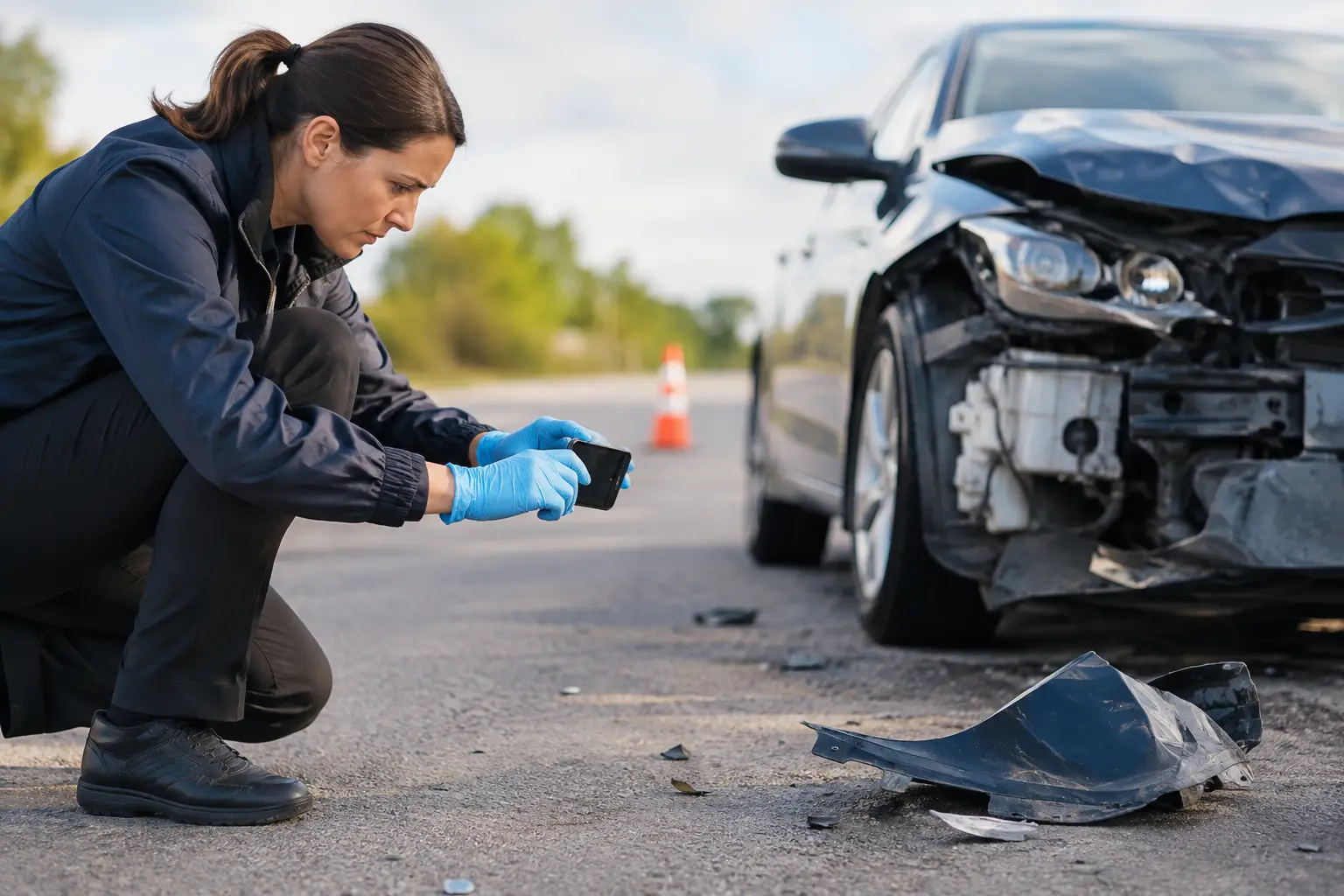
A crash can turn an ordinary drive into a day of sirens, pain, tow trucks, and unanswered questions. In those first difficult hours, preserving crash scene evidence may protect more than a vehicle or a photograph. It can help show what happened before an insurance company gets the chance to shape the story around its own interests.
You do not have to conduct an investigation while you are injured or shaken. Your first responsibility is getting to safety and receiving medical care. But when it is safe to do so, a few careful steps can preserve details that may disappear by the time an adjuster calls.
Start With Safety, Then Document What You Can
Move out of traffic if possible, call 911, and accept medical evaluation when you need it. A serious injury is not always obvious at the scene. Adrenaline can mask pain from a concussion, neck injury, back injury, or internal trauma. Let first responders do their work, and do not put yourself in harm’s way to take pictures.
If you can safely use your phone, take broad photographs before close-up shots. Wide images can place the vehicles in relation to an intersection, lane markings, traffic signals, ditches, construction zones, or debris fields. Then capture the damage to every vehicle involved, including impact points, broken glass, deployed airbags, skid marks, tire tracks, and fluid on the roadway.
A useful set of photographs often includes:
- Each vehicle from several angles, including license plates and company markings
- The road surface, weather conditions, signs, signals, and obstructions to visibility
- Debris, damaged guardrails, broken pavement, or anything that may have affected the collision
- Visible injuries, torn clothing, damaged helmets, child seats, or personal property
Take a short video if it helps show the layout of the scene. Speak plainly in the recording only if you can do so accurately. Avoid guessing about speed, fault, or what another driver may have been doing. A picture of a traffic light is useful. A rushed statement about who caused the wreck may be used against you later.
Preserving Crash Scene Evidence Before It Disappears
Crash scenes change quickly. Vehicles are towed, rain washes away marks on the pavement, and a business may record over surveillance footage within days. That is why time matters, particularly after an intersection collision, a motorcycle crash, or a wreck involving a commercial truck.
Keep the original photo and video files whenever possible. Do not rely only on images posted to social media or sent by text message, since those versions may be compressed or stripped of details. Back up the original files to a secure location and write down the date, time, and place if your phone did not capture it accurately.
Get names and contact information for witnesses if they are willing to provide it. A witness does not need to decide fault at the roadside. Their account of a red light, sudden lane change, distracted driver, or the moments after impact may become valuable if the other driver changes their version later. Ask for a name and phone number, then allow your attorney to follow up rather than pressuring someone for a full statement.
The same principle applies to physical items. Do not throw away a damaged helmet, torn clothing, broken eyeglasses, child safety seat, or vehicle part without first discussing it with counsel. These items can help explain the force of a collision and the real-world consequences for the people inside the vehicle.
The Evidence You Cannot Collect Yourself
Some of the most meaningful evidence is outside an injured person’s control. Police may prepare a crash report, photographs, diagrams, and witness information. Emergency dispatch records can show when a call was made and what was reported. Nearby homes, businesses, schools, or traffic cameras may have video of the collision or the moments leading up to it.
These records are not always kept forever. Video systems often overwrite recordings on a short cycle. A prompt request to preserve footage can make a major difference, but the request needs to reach the right person and clearly identify the date, approximate time, and location.
Vehicle data can also matter. Many newer vehicles record information connected to a crash, such as braking, steering, speed changes, seat belt use, and airbag deployment. The available data differs by vehicle, and it may require careful collection before a car is repaired, sold, or declared a total loss. Do not authorize destruction of the vehicle simply because the insurance company wants the claim moving quickly.
A lawyer can work to identify and preserve these sources while you focus on treatment and your family. That investigation may include reviewing roadway conditions, inspecting vehicle damage, locating witnesses, and requesting records before they are lost.
Truck Crashes Require Fast Action
An 18-wheeler or commercial vehicle crash can involve evidence far beyond the roadway. The trucking company may possess driver logs, inspection records, maintenance files, dispatch communications, onboard camera footage, electronic logging data, and information from the truck’s electronic control module.
Those materials may clarify whether a driver was speeding, braking late, driving too long, following too closely, or operating a poorly maintained vehicle. They may also reveal whether company decisions played a role. Trucking companies and their insurers often begin building their defense immediately after a serious collision. Injured families deserve the same urgency in protecting the facts.
Do not assume the police report will contain every answer. A report is an important starting point, but it is not a complete reconstruction of every crash. In a serious truck collision, early legal action to preserve company-controlled records may be necessary.
Protect Evidence After the Tow Truck Leaves
The need to preserve proof does not end once the road is cleared. Save all documents connected to the wreck, including the exchange-of-information sheet, towing and storage paperwork, repair estimates, rental-car records, medical bills, prescriptions, and correspondence from insurers. Keep a simple journal of appointments, symptoms, missed work, and activities you can no longer manage normally.
This record is not about dramatizing your injuries. It is about making sure the day-to-day impact is not erased. A back injury that makes lifting a child difficult, a brain injury that affects concentration, or burns that require repeated care can change a family’s life in ways a single medical bill cannot fully show.
Be cautious before giving a recorded statement to the other driver’s insurer. Adjusters may sound concerned, but their company has a financial interest in limiting what it pays. You can report the basic facts needed for your own policy, but it is reasonable to seek legal guidance before giving a detailed statement, signing a broad medical release, or accepting an early settlement offer.
It also helps to stay off social media when possible. A smiling photo at a family gathering does not reveal the pain, medication, or recovery time behind it, yet insurers may try to use isolated posts to question an injury claim. Privacy settings are not a guarantee that a post will remain private.
When Evidence Is Lost or Unclear
Not every crash will have a clear video, neutral witness, or perfect photograph. That does not mean a claim is over. The available proof may include vehicle damage patterns, accident reconstruction, medical records, phone records obtained through proper legal channels, roadway design, and testimony from the people involved.
Still, delay can make a difficult case harder. Memories fade, vehicles are repaired, and records are routinely discarded. The trade-off is real: families often need breathing room after a traumatic wreck, while evidence may need attention right away. Getting an early consultation can protect your options without forcing you to make immediate decisions about a settlement or lawsuit.
For families in Monroe, Bastrop, and surrounding communities, Downs Law Firm can help take over the work of protecting records and confronting insurance-company pressure. There is no upfront fee for an injury claim, and the goal is to give your family room to heal while the facts are pursued with care.
After a serious crash, do not let the strongest proof disappear in the confusion of the first few days. Put your health first, save what you safely can, and get guidance before the evidence and your leverage are gone.